
Your car hits a small bump and suddenly feels like a boat. The steering wheel needs constant little corrections. One tire looks more worn than the others. Or maybe there is a new clunk every time you pull into a driveway.
None of these symptoms automatically means the suspension is falling apart. But they are worth paying attention to.
The suspension does far more than make a car comfortable. It helps keep the tires planted on the road, controls body movement, supports predictable steering, and allows the vehicle to remain stable while braking, turning, and accelerating.
That is why auto suspension repair is not simply about getting rid of annoying noises. A worn component can affect tire wear, wheel alignment, braking feel, and how confidently the vehicle responds when something unexpected happens on the road.
The tricky part? Suspension problems often develop slowly. Drivers get used to them.
A car that once felt tight and controlled may gradually start bouncing, wandering, or leaning more in corners. Because the change happens over months or years, it can feel normal until someone else drives the car and says, “Whoa, has it always handled like this?”
Usually, no.
What Is the Suspension System?
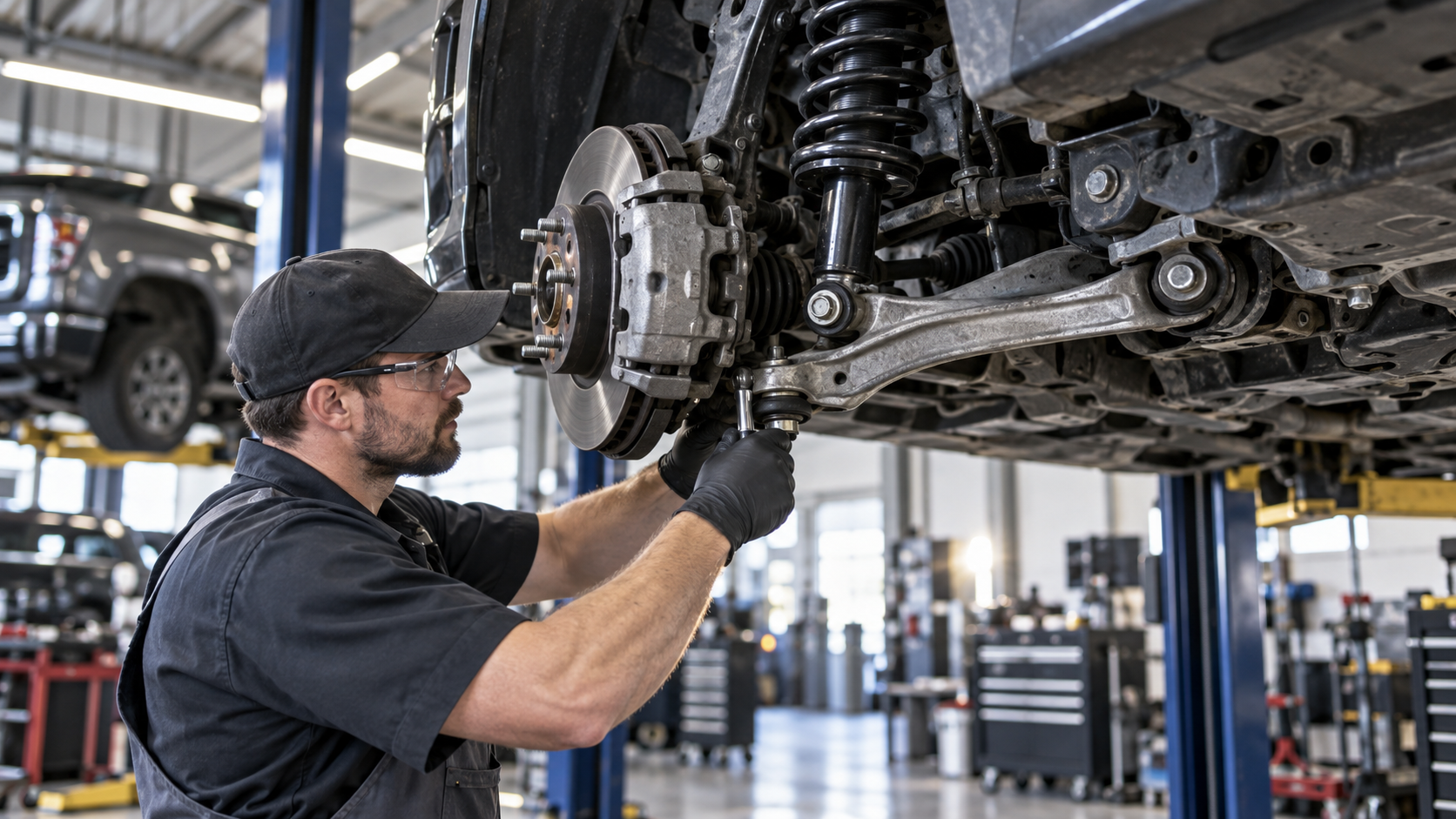
Your suspension is a network of parts connecting the vehicle body to the wheels.
The exact design varies. A compact front-wheel-drive car may have a different setup than a body-on-frame pickup, sports coupe, or luxury SUV with electronically controlled dampers.
Still, the basic job is similar: allow the wheels to move over uneven pavement while keeping the vehicle controlled.
Common suspension-related components include:
- Shocks and struts.
- Coil springs or leaf springs.
- Control arms.
- Ball joints.
- Control-arm bushings.
- Sway bars and sway-bar links.
- Steering knuckles.
- Upper strut mounts and bearings.
- Air springs on vehicles with air suspension.
Some vehicles also combine suspension parts into larger assemblies. A strut, for example, is not simply another name for a shock absorber. A strut usually forms a structural part of the suspension assembly and may help locate the wheel.
Why Suspension Problems Can Be Easy to Miss
A broken suspension spring may be obvious. A slightly worn bushing usually is not.
Many suspension parts are rubber, metal, hydraulic, or a combination of those materials. They wear gradually through normal movement, heat, water, salt, road dirt, potholes, curb impacts, and age.
The car compensates surprisingly well for a while.
Then little clues begin to show up.
Maybe the front end feels less precise. Maybe the car takes an extra bounce after crossing a speed bump. Maybe you hear a dull knock from one corner on rough pavement.
Those small changes are often where suspension diagnosis starts.
Common Signs You May Need Suspension Repair
No single symptom confirms a bad suspension component. Several systems can produce similar sensations, so inspection matters.
| Symptom | Possible Suspension Cause | What Else Could Cause It |
|---|---|---|
| Clunk over bumps | Ball joint, bushing, sway-bar link, strut mount | Loose exhaust or other chassis hardware |
| Excessive bouncing | Worn shocks or struts | Tire pressure or tire damage |
| Car pulls to one side | Alignment or worn suspension parts | Tire pressure, tire damage, brake drag |
| Uneven tire wear | Alignment, worn bushings, ball joints | Incorrect inflation or tire problems |
| Vehicle leans in turns | Weak dampers, sway-bar issue, spring problem | Some body roll may be normal |
| Steering feels loose | Ball joints, bushings, suspension wear | Tie rods or steering-system faults |
| One corner sits low | Broken spring or air-suspension fault | Vehicle loading or tire issue |
Notice the pattern here: suspension diagnosis is often about ruling things out.
A car pulling right does not automatically need control arms. A steering shake does not automatically mean bad struts. And a clunk is not proof that a ball joint has failed.
Good diagnosis saves money because suspension parts are interconnected. Replacing parts based on a guess can get expensive fast.
The Car Keeps Bouncing After a Bump
One of the classic suspension complaints is excessive bouncing.
A healthy vehicle should absorb a bump, move through its suspension travel, and settle fairly quickly.
If the body keeps floating up and down afterward, worn shocks or struts become a reasonable suspect.
Shock absorbers and struts control spring movement. Springs carry much of the vehicle’s weight and allow wheel movement; dampers control how rapidly that movement happens.
Without effective damping, the springs would continue oscillating.
That is where the old “push down on the fender and count the bounces” test came from. But modern suspension systems vary so much that this driveway test is not a reliable diagnosis by itself.
A road test and physical inspection tell you far more.
Shocks vs. Struts: What’s the Difference?
People often use the terms interchangeably, but they are not always the same thing.
A conventional shock absorber mainly controls suspension movement.
A strut normally serves as both a damper and an important structural component of the suspension assembly.
A strut assembly may include the spring, upper mount, bearing, dust boot, bump stop, and other parts.
That also means replacing a strut can be a more involved job than replacing a simple shock.
After certain strut repairs, wheel alignment may need to be checked because removing or reinstalling the strut can affect suspension geometry.
Can Worn Shocks Really Affect Safety?
Yes, although the effect may not feel dramatic during easy driving.
Damaged or severely worn dampers can reduce the suspension’s ability to control tire movement over rough surfaces.
That can affect vehicle stability, particularly during hard braking, emergency lane changes, uneven-road driving, or wet conditions.
The tire needs consistent contact with the road to generate predictable grip.
If a wheel is bouncing instead of following the pavement, the vehicle may not respond as cleanly as it should.
What a Bad Ball Joint Feels Like
Ball joints act as pivot points in the suspension.
They allow wheel and suspension movement while maintaining a controlled connection between components.
Wear can produce clunking, looseness, inconsistent steering feel, or abnormal tire wear.
In more serious cases, excessive ball-joint play can become a safety issue because the joint helps keep the wheel assembly properly connected and located.
This is one suspension component where “I’ll deal with it someday” is not a great strategy if a technician confirms significant wear.
If you hear heavy clunks and the steering suddenly feels loose or unstable, have the vehicle inspected promptly.
Control Arms and Bushings: Quiet Parts That Matter a Lot
Control arms connect the wheel assembly to the vehicle structure while allowing controlled suspension movement.
They often use rubber or hydraulic bushings at their mounting points.
Those bushings absorb vibration and allow a carefully controlled amount of movement.
As they age, rubber can crack, split, soften, or separate from its housing.
The result might be a clunk while accelerating or braking, unstable steering, changing alignment angles, or uneven tire wear.
Sometimes a worn bushing looks dramatic. Other times it only shows excessive movement when the suspension is properly loaded during inspection.
Why Your Car May Clunk When Braking or Accelerating
Suspension loads change when the vehicle speeds up and slows down.
During braking, weight shifts forward. During acceleration, load shifts toward the rear.
If a control-arm bushing, ball joint, or another mounting point has excessive play, the component can move suddenly as forces change direction.
That can produce the classic “thunk” or “clunk.”
But engine mounts and drivetrain parts can make similar noises, so the location of the sound matters.
A clunk from directly under the engine bay while shifting from Reverse to Drive may point somewhere different from a knock heard from one front wheel while crossing a speed bump.
Sway-Bar Links Can Make a Surprising Amount of Noise
Sway bars, also called stabilizer bars or anti-roll bars, help manage body roll during turns.
Small links connect the bar to suspension components.
Those links can wear at their joints or bushings.
When they do, they may create repetitive rattling or knocking over small bumps, broken pavement, or driveway entrances.
The noise can sound more alarming than the actual repair.
That’s one reason you do not want to diagnose suspension problems by sound alone. A relatively inexpensive link and a more substantial suspension problem can sound strangely similar from the driver’s seat.
Broken Springs Are Not Always Easy to Spot
Coil springs are strong, but they can break.
Corrosion, fatigue, road conditions, and impact damage can contribute over time.
Sometimes a spring breaks near the end of a coil, and the change in ride height is surprisingly small.
You might hear a metallic noise when steering or driving over bumps. One corner may sit lower. The broken end can sometimes contact the spring seat or nearby components.
Do not reach around a damaged spring while the suspension is loaded.
Coil springs store considerable energy and require proper tools and procedures during removal.
Air Suspension Adds Another Layer
Some luxury cars, SUVs, and trucks use air springs instead of conventional steel springs, or combine air suspension with electronically controlled dampers.
These systems can provide impressive comfort and automatic ride-height control.
They also introduce additional components such as compressors, air lines, valves, height sensors, control modules, and air springs.
If an air spring leaks, one corner of the vehicle may sink after parking overnight.
If the compressor struggles to maintain pressure, it may run frequently or eventually overheat.
And sometimes the problem is not the air spring at all. A sensor, wiring fault, valve, or air-line leak may be responsible.
Uneven Tire Wear Is a Suspension Clue
Tires tell stories.
If one edge is wearing much faster than the rest, wheel alignment may be incorrect.
If the tread develops cupping or scalloped patches, a worn suspension component or damper may be involved, although tire balance and other issues can contribute too.
Watch for:
- Inside-edge or outside-edge wear.
- Cupped or scalloped tread.
- One tire wearing much faster than its partner.
- Feathered tread blocks.
- Visible cracking, bulging, or deformation.
- Repeated alignment problems after adjustments.
If a shop aligns the vehicle and the settings quickly move out again, there may be worn parts allowing the wheel geometry to change.
Alignment cannot permanently correct looseness in a damaged component.
Suspension and Wheel Alignment Are Closely Connected
Wheel alignment describes the angles at which the wheels sit relative to the vehicle and road.
Important angles include camber, caster, and toe.
Suspension components help establish and maintain those angles.
If a bushing moves excessively or a ball joint has play, wheel position can change while driving.
That is why a good shop often checks for worn suspension and steering parts before performing an alignment.
Aligning a car with loose components can be a little like straightening a picture frame on a wall while the nail itself is falling out.
You can make it look right for a moment, but the underlying problem remains.
Do You Need an Alignment After Suspension Repair?
Sometimes, yes.
It depends on which components were replaced and whether the repair affects wheel geometry.
Struts, control arms, ball joints, tie rods, and several other components can influence alignment.
Even when a repair theoretically returns everything to the original position, small manufacturing tolerances and installation differences can matter.
Checking alignment after major suspension work is often sensible.
Your repair shop should be able to explain whether alignment is recommended for the specific job.
What Happens During a Suspension Inspection?
A proper inspection is more than someone looking underneath the car for 20 seconds.
The technician may road-test the vehicle first, especially if the complaint involves noise, pulling, bouncing, or instability.
Then the vehicle is lifted so joints, bushings, mounts, springs, dampers, and related steering components can be inspected.
Depending on the symptom, the technician may check for free play, damaged rubber, fluid leakage, cracked springs, loose fasteners, abnormal wheel movement, or signs of impact damage.
Tires are often part of the diagnosis too.
A damaged tire can imitate suspension trouble surprisingly well.
What a Mechanic May Check
- Shock and strut condition.
- Strut mounts and bearings.
- Control-arm bushings.
- Ball-joint play.
- Sway-bar links and bushings.
- Springs and spring seats.
- Steering tie rods.
- Wheel bearings and hubs.
- Tire wear and inflation.
- Wheel alignment clues.
- Evidence of curb or pothole impact.
The important word here is “system.”
Suspension parts influence one another, so replacing the noisiest-looking piece without checking the rest can miss the actual cause.
How Much Does Auto Suspension Repair Cost?
There is no useful single price because “suspension repair” can mean anything from replacing one small sway-bar link to replacing multiple struts, control arms, mounts, springs, and performing an alignment afterward.
Labor rates also vary widely across the United States.
Vehicle design matters just as much.
A conventional shock on a basic pickup may be straightforward. An electronically controlled strut on a luxury vehicle can be far more expensive. Air suspension adds compressors, sensors, valves, and air springs to the equation.
| Repair Type | What Often Affects the Price | Possible Extra Work |
|---|---|---|
| Shock replacement | Vehicle design, shock type, accessibility | Inspection of mounts and tires |
| Strut replacement | Complete assembly vs. individual components | Alignment may be recommended |
| Control-arm replacement | Arm design, integrated ball joint, labor access | Alignment |
| Ball-joint replacement | Press-in, bolt-in, or integrated design | Alignment or related hardware |
| Spring replacement | Spring type and labor required | Mounts, isolators, alignment check |
| Air-suspension repair | Air spring, compressor, sensors, valves, electronics | System calibration or diagnosis |
If you receive a quote, ask what is included rather than comparing only the final number.
Does it include both sides? New mounts? Alignment? Hardware? Diagnostic time?
Two estimates that look wildly different may actually cover different amounts of work.
Do Suspension Parts Need to Be Replaced in Pairs?
Some do, depending on the part and condition.
Shocks and struts are commonly replaced in left-right pairs on the same axle because balanced damping is desirable.
If one strut has failed from normal wear and the other has the same mileage, replacing only one may leave different damping characteristics from side to side.
Other parts do not automatically require pair replacement.
If one control arm was damaged by a pothole and the opposite side is healthy, replacing both may not always be necessary.
The right approach depends on the component, mileage, vehicle design, wear, and manufacturer recommendations.
Can You Drive With Bad Suspension?
That depends entirely on what is bad.
A noisy sway-bar link is different from a severely worn ball joint.
A slightly worn shock is different from a broken spring rubbing against a tire.
Stop driving and arrange professional help if the vehicle suddenly becomes difficult to steer, one wheel looks out of position, a tire is rubbing against suspension parts, the vehicle drops significantly on one corner, or you hear heavy grinding or metal-on-metal noises.
Significant ball-joint or control-arm failure can be serious.
If you are unsure whether a suspension fault is safe to drive on, an inspection is a better gamble than testing the answer on the highway.
What Happens If You Ignore Suspension Problems?
Sometimes the first consequence is simply discomfort.
The ride gets noisy. The steering feels sloppy. The car bounces.
But worn suspension parts can also create secondary costs.
Incorrect wheel movement can accelerate tire wear. A bad damper can contribute to irregular tread wear. A loose component can affect alignment. One damaged part may place additional stress on nearby components.
And eventually, what started as “that little clunk” may become an obvious handling problem.
Getting an inspection does not mean agreeing to every suggested repair. It simply tells you what is actually happening.
Potholes Can Do More Than Ruin Your Morning
Anyone who drives through parts of the U.S. with rough winter roads knows the sound.
Bang.
Then comes the immediate check of the steering wheel: “Is the car still driving straight?”
A hard pothole hit can damage tires, bend wheels, disturb alignment, or damage suspension parts.
If the vehicle begins pulling, vibrating, clunking, or sitting differently after a major impact, have it checked.
And inspect the tire sidewall closely. A bulge after a pothole impact can indicate internal tire damage even if the tire still holds pressure.
Can Suspension Problems Make the Steering Wheel Shake?
Yes, although tires and wheels are frequent causes of steering-wheel vibration.
Loose ball joints, worn bushings, steering linkage issues, wheel bearings, and other front-end problems can contribute.
The speed and conditions matter.
A shake that begins at a specific highway speed may suggest wheel or tire imbalance. A clunk and steering movement over bumps may point more toward suspension or steering components.
A shake only under braking moves the diagnostic conversation toward brakes and related components.
Again, the pattern matters more than the word “shake.”
Can Bad Suspension Cause a Car to Pull?
Yes.
Worn components can change wheel alignment or allow the wheel to shift under load.
But pulling can also come from uneven tire pressure, tire construction differences, road crown, alignment settings, or a dragging brake.
If your car suddenly begins pulling strongly to one side, check tire pressure first.
If the pressures are correct and the problem remains, an inspection and alignment check make sense.
Do New Shocks Make a Big Difference?
If the old dampers are genuinely worn, the difference can be surprisingly noticeable.
The car may feel more settled over bumps. Body movement may decrease. Highway driving may feel less floaty. Nose dive during braking can improve.
But new shocks will not fix worn control-arm bushings, incorrect alignment, damaged tires, or loose steering components.
That sounds obvious, yet it is easy to throw shocks at every ride-quality complaint because they are the suspension part most drivers know by name.
DIY Suspension Repair: Where to Be Careful
Some suspension repairs are manageable for experienced home mechanics with the correct tools.
Others involve serious stored spring energy, heavy components, pressed joints, precise torque procedures, or alignment-sensitive parts.
Coil springs deserve particular respect.
An improperly controlled spring can release enough energy to cause severe injury.
Never work under a vehicle supported only by a jack. Proper jack stands or professional lifting equipment are essential.
And after replacing safety-critical steering or suspension parts, torque specifications matter. “Pretty tight” is not a substitute for the manufacturer’s procedure.
How to Describe the Problem to a Repair Shop
This may save more diagnostic time than you expect.
Instead of saying, “My suspension sounds bad,” describe exactly what happens.
For example:
“I hear one dull clunk from the right front when I pull into a driveway at low speed.”
That is useful.
Or:
“The car feels floaty above 60 mph and bounces twice after large highway dips.”
Even better.
Tell the technician when the problem started and whether the car recently hit a pothole, curb, or object in the road.
Details turn noises into clues.
FAQ
How do I know if my suspension needs repair?
Common clues include clunking over bumps, excessive bouncing, uneven tire wear, loose steering, pulling, unusual body roll, or one corner of the car sitting lower than the others. Inspection is needed to identify the exact part.
What causes suspension clunking?
Worn sway-bar links, control-arm bushings, ball joints, strut mounts, or loose suspension hardware can all create clunks. Drivetrain and steering parts can make similar noises.
Can bad suspension ruin tires?
Yes. Worn suspension parts can affect wheel alignment and tire movement, leading to uneven or accelerated tread wear.
Should shocks and struts be replaced in pairs?
They are commonly replaced in pairs on the same axle so damping remains balanced from left to right. The exact recommendation depends on vehicle design and the condition of both components.
Do I need an alignment after suspension repair?
Many repairs involving struts, control arms, ball joints, or other wheel-positioning components may require an alignment check. Your technician can confirm this for the specific repair.
Is it dangerous to drive with bad suspension?
Some suspension faults are mainly annoying, while others can affect steering or wheel control. Severe ball-joint wear, broken springs, loose control arms, or major structural problems should be treated seriously.
How long does suspension repair take?
It depends on the job. A simple link or shock replacement may be relatively quick, while struts, control arms, air-suspension diagnosis, or several worn components can require considerably more labor.
Conclusion
Suspension problems rarely begin with one dramatic announcement.
More often, they creep in.
A small clunk. A little extra bounce. A steering wheel that needs more correction than it used to. A tire wearing strangely on the inside edge.
That is why paying attention matters.
Your suspension is responsible for more than comfort. It controls how the wheels move, helps keep the tires in contact with the road, and plays a major role in predictable steering and handling.
If something feels different, start with the pattern.
Does the noise happen over bumps? While braking? During turns? Only at highway speed? Is it coming from the front, rear, left, or right?
Then look at the tires.
Uneven wear, incorrect pressure, bulges, or damage can either imitate suspension trouble or reveal that something underneath the car is no longer holding the wheel where it should.
And do not assume every clunk means an expensive repair.
A worn sway-bar link can make an impressive racket. A loose or deteriorated bushing may create symptoms that feel much worse than the part itself looks.
At the same time, do not dismiss every suspension noise as harmless.
Ball joints, control arms, springs, and other components physically locate and support the wheels. Serious wear can affect vehicle control.
The smartest approach is diagnosis before parts.
A technician should inspect the suspension, steering, wheels, and tires and connect what they find with the symptoms you actually experience.
If the shop recommends several repairs, ask them to show you what is worn and explain which items are urgent, which affect alignment or tire wear, and which can reasonably wait.
That makes a suspension quote much easier to understand.
Also remember that wheel alignment is part of the bigger picture.
A perfect alignment cannot compensate for loose suspension parts. If a wheel is moving because a bushing or joint is worn, the alignment numbers may look good while the car is on the rack and change again when the vehicle is driven.
Repair the looseness first. Align afterward when appropriate.
One more thing: suspension wear is often gradual enough that you forget what the car used to feel like.
After genuinely worn dampers, bushings, or joints are repaired, the difference can be striking. The vehicle may feel calmer, tighter, quieter, and far more predictable.
That is not because the repair turned it into a new car.
It simply brought back control that slowly disappeared over time.
So if your vehicle has started bouncing, clunking, wandering, leaning, or eating through tires, do not keep guessing.
Get the suspension inspected.
The problem may be small. It may need attention soon. Or it may be something that should be repaired before you keep driving.
Either way, knowing what is actually worn is far cheaper than replacing suspension parts one guess at a time.
Leave a Reply