
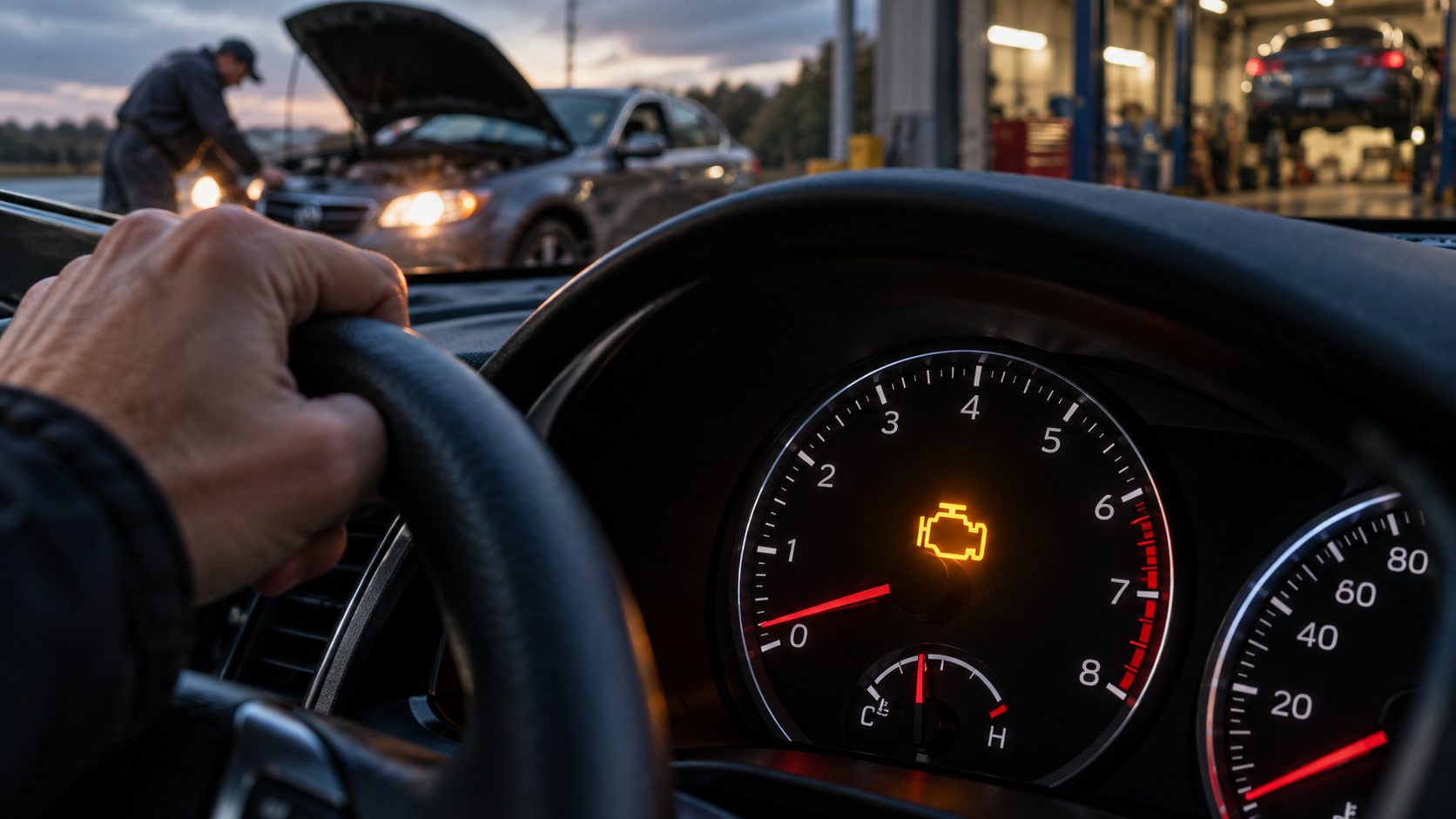
You are driving normally, glance at the dashboard, and there it is: the check-engine light. Except this time it is not simply glowing. It is blinking.
That little difference matters.
An engine light flashing often means the vehicle’s onboard diagnostic system has detected a serious engine misfire. In many cases, continuing to drive hard can allow unburned fuel to reach the catalytic converter, where excessive heat can damage an expensive emissions component.
So, yes, this is one dashboard warning that deserves attention sooner rather than later.
That does not mean every flashing light predicts catastrophic engine failure. Sometimes the root problem is a worn spark plug or a failing ignition coil. Those are common repairs. But until the cause is known, the smart move is to reduce engine load and assess how the car is behaving.
Is it shaking? Has it lost power? Does the light flash only when accelerating uphill? Can you smell fuel? Did the warning begin immediately after filling the tank?
Those details matter because the check-engine light itself does not tell you which part failed. It tells you the engine-control system has detected something outside its expected range.
Flashing vs. Solid Check-Engine Light
A solid check-engine light and a flashing one should not be treated exactly the same way.
A steady light generally means a fault has been detected and stored. The car may still drive normally, although it should be diagnosed rather than ignored.
A flashing light is more urgent. It is commonly associated with an active misfire severe enough that continued driving could increase emissions and potentially overheat the catalytic converter.
| Check-Engine Light Behavior | What It Often Means | What to Do |
|---|---|---|
| Solid light, car drives normally | A fault has been detected | Schedule diagnosis soon |
| Solid light with poor running | Engine or emissions problem affecting performance | Drive cautiously or arrange inspection |
| Flashing light | Often an active, potentially damaging misfire | Reduce load and stop driving if symptoms are severe |
| Flashing light plus shaking or power loss | Significant combustion problem | Pull over safely and consider towing |
| Light accompanied by oil-pressure or overheating warning | Potentially serious engine condition | Stop safely and investigate immediately |
There is an important nuance here. The check-engine light monitors many systems, while oil-pressure and temperature warnings cover different problems. A flashing check-engine light is serious, but an oil-pressure warning or overheating condition can require an even faster shutdown.
What Does a Misfire Actually Mean?
An engine needs the right amount of air, fuel, compression, and ignition at the right moment.
When combustion fails or happens incorrectly in one or more cylinders, the engine can misfire.
You may feel it as a stumble, shake, hesitation, or rhythmic vibration. Sometimes the car feels as though someone is briefly tapping the brake while you accelerate.
Other times the misfire is subtle enough that the driver notices only the warning light.
The engine-control module monitors crankshaft speed closely. When one cylinder stops contributing normally, crankshaft acceleration changes slightly. The computer can detect that pattern and may store a diagnostic trouble code identifying the affected cylinder or indicating random misfires.
For example, a code pointing to cylinder 3 means the computer detected a misfire there. It does not automatically mean the ignition coil on cylinder 3 must be replaced.
That’s where diagnosis begins, not where it ends.
Why a Misfire Can Damage the Catalytic Converter
Normally, fuel burns inside the combustion chamber.
During a significant misfire, some fuel may leave the cylinder without burning properly. It then travels into the exhaust system.
The catalytic converter operates at high temperatures already. When extra fuel burns inside or near the converter, temperatures can rise much higher.
That can damage the internal catalyst material.
And this is where a small ignition problem can turn into a much larger bill.
A spark plug or ignition coil might be relatively straightforward to replace. A catalytic converter, especially on newer vehicles or models with multiple converters, can be considerably more expensive.
So when an engine light flashing warning appears under acceleration, it is generally a bad idea to keep flooring the throttle just to see whether the problem goes away.
What Causes a Flashing Check-Engine Light?
The most common path leads back to misfires, but several different failures can cause them.
- Worn, damaged, or incorrectly gapped spark plugs.
- Weak or failing ignition coils.
- Damaged ignition wires on vehicles that still use them.
- Fuel injector problems.
- Low or unstable fuel pressure.
- Vacuum or intake-air leaks.
- Incorrect air-fuel mixture.
- Compression loss in one or more cylinders.
- Valve-train or camshaft problems.
- Timing issues.
- Electrical connectors, wiring, or sensor faults affecting combustion.
Some causes are simple. Some are not.
That’s why guessing based on one diagnostic code can waste money.
Spark Plugs: Small Part, Big Effect
Spark plugs have a straightforward job: ignite the compressed air-fuel mixture inside gasoline-engine cylinders.
They operate in an extremely hot, high-pressure environment and gradually wear.
A worn plug may still fire normally during gentle cruising but struggle when cylinder pressure rises during hard acceleration.
That is why some drivers first notice a flashing check-engine light while climbing a hill, merging onto the freeway, or passing another car.
The engine is under more load. A marginal ignition system suddenly has to work harder.
Spark-plug condition should be evaluated against the vehicle manufacturer’s service schedule and specifications rather than one universal mileage rule. Plug type, engine design, and operating conditions differ considerably.
Ignition Coils Can Fail in a Similar Way
Modern gasoline engines commonly have individual coils mounted near or directly on the spark plugs.
Each coil generates the high voltage required to create a spark.
A weak coil may work intermittently. Heat can make the problem worse. So can high engine load.
The car may run fine when cold and begin misfiring after twenty minutes. Or it may idle smoothly but shake as soon as you accelerate.
If a scan shows a misfire on one cylinder, a technician may compare ignition operation between cylinders, inspect the plug, check wiring, and perform other tests before deciding the coil itself is responsible.
Replacing every coil automatically because one cylinder misfires is not always necessary.
Fuel Injectors Can Cause Misfires Too
Ignition gets much of the attention, but combustion also depends on proper fuel delivery.
A clogged, electrically faulty, or mechanically damaged injector may deliver too little fuel, too much fuel, or an inconsistent spray pattern.
The result can be rough running and misfires.
Low fuel pressure can affect several cylinders, especially when the engine needs more fuel during acceleration.
This is another reason a car may appear almost normal around town yet stumble badly when you ask for power.
Can Bad Gas Make the Engine Light Flash?
Fuel quality problems can contribute to rough running, although they are not the explanation for every warning light that appears after a fill-up.
If symptoms begin immediately after buying fuel, tell the technician where and when you filled the tank.
Water contamination, incorrect fuel, or fuel with characteristics unsuitable for the vehicle can cause drivability problems.
But don’t assume “bad gas” before checking for ignition, fuel-delivery, or mechanical faults. Timing can be coincidental.
Can a Loose Gas Cap Cause a Flashing Light?
A loose or damaged fuel cap can trigger an emissions-related check-engine warning on vehicles that monitor the evaporative emissions system.
But it is much more commonly associated with a steady check-engine light than a flashing one.
If the engine is shaking and the light is blinking, tightening the gas cap is unlikely to explain the whole situation.
It’s fine to check the cap. Just don’t let that delay diagnosis of an obvious misfire.
Why Is the Engine Light Flashing When I Accelerate?
This is a very common pattern.
Acceleration increases cylinder pressure and fuel demand. Weak ignition components or marginal fuel-delivery problems often show themselves under those conditions.
Imagine a spark plug that works fine while cruising at 35 mph.
Then you climb a freeway ramp, press the gas harder, and the engine suddenly starts stumbling. The light flashes for several seconds and may stop once you ease off.
That does not mean the problem disappeared.
It means the fault became severe enough to detect under load and then became less noticeable when the load dropped.
Why Does It Flash Going Uphill?
Driving uphill is basically a built-in engine load test.
The engine must produce more torque, which increases demand on the ignition and fuel systems.
A weak coil, worn spark plug, restricted injector, low fuel pressure, or mechanical problem may become obvious only on a hill.
If your engine light flashing problem consistently appears uphill, remember that pattern when you describe the symptom to a repair shop.
“It flashes between 45 and 60 mph while climbing and stops when I lift off the gas” is far more useful than “sometimes the light comes on.”
What if the Car Is Shaking Too?
A flashing check-engine light plus noticeable shaking strongly suggests that at least one cylinder is not producing power normally.
You may feel the vibration through the steering wheel, seat, or entire vehicle.
At idle, the engine may sound uneven. The exhaust note may pulse strangely. Acceleration may become sluggish.
This is not a symptom to test by driving another 30 miles and hoping for the best.
If the shaking is severe, reduce speed, move somewhere safe, and shut the engine off.
Towing may cost money, sure. But continuing to drive a badly misfiring engine can turn one repair into several.
What if the Light Flashes for a Few Seconds and Stops?
Do not ignore it.
An intermittent flashing light can mean the misfire occurs only under certain conditions.
The computer may still store diagnostic information even after the dashboard light returns to normal.
Conditions worth remembering include:
- Vehicle speed when the flashing started.
- Whether the engine was cold or fully warmed up.
- Whether you were accelerating, cruising, or climbing a hill.
- Engine rpm if you noticed it.
- Outside temperature and weather.
- Whether the car shook, hesitated, or lost power.
- Whether the warning stopped after easing off the accelerator.
- Recent fuel fill-ups or engine work.
Those observations can help reproduce an intermittent problem.
Can You Drive With the Check-Engine Light Flashing?
The safest answer depends on how the vehicle is behaving.
If the light briefly flashes but the engine feels normal, reducing engine load and arranging prompt diagnosis is sensible.
If the light continues flashing and the engine shakes, hesitates, smells strongly of fuel, or loses substantial power, continuing to drive is not a good plan.
Pull over somewhere safe.
If the car has severe symptoms, arrange a tow rather than trying to nurse it across town.
You should also stop if other serious warnings appear, especially low oil pressure or overheating.
When Should You Stop Immediately?
A check-engine warning becomes much more concerning when other symptoms arrive with it.
- Severe engine shaking or bucking.
- Major loss of acceleration.
- Strong raw-fuel smell.
- Smoke from the engine compartment or exhaust.
- Engine overheating.
- Oil-pressure warning light.
- Heavy knocking or metallic engine noise.
- Vehicle repeatedly stalling.
- Sudden abnormal exhaust noise.
If any of these appear, find a safe place to stop rather than trying to diagnose the car while moving.
What Diagnostic Codes Are Common With Misfires?
OBD-II systems may store codes in the P0300 family when misfires are detected.
| Example Code | General Meaning | What It Does Not Automatically Prove |
|---|---|---|
| P0300 | Random or multiple-cylinder misfire detected | Which exact part has failed |
| P0301 | Misfire detected on cylinder 1 | That cylinder 1 ignition coil is definitely bad |
| P0302 | Misfire detected on cylinder 2 | That a spark plug alone caused it |
| P0303 | Misfire detected on cylinder 3 | That an injector must be replaced |
| P0304 | Misfire detected on cylinder 4 | That there is no mechanical problem |
Engines with more cylinders can store additional cylinder-specific codes following the same general pattern.
A scan tool is useful because it tells you what the computer observed. But reading codes is not the same as diagnosing the vehicle.
This distinction saves people a lot of money.
Why Reading a Code Is Only Step One
Suppose a scanner reports P0302.
Some people immediately order a cylinder 2 ignition coil.
Maybe that fixes it. Maybe not.
Cylinder 2 could also have a worn spark plug, injector fault, wiring problem, vacuum leak affecting that cylinder, low compression, valve issue, or another mechanical problem.
A technician may inspect the plug, test ignition operation, compare injector behavior, examine fuel trims, check compression, and review live engine data.
The exact process depends on the vehicle and symptoms.
That’s why “the scanner said coil” should make you a little suspicious. Diagnostic trouble codes normally identify a detected condition or circuit problem, not magically name every failed part.
Could Low Compression Cause a Flashing Light?
Yes.
Combustion requires sufficient compression.
If a cylinder cannot seal properly, it may misfire even when spark and fuel delivery are working.
Possible mechanical causes include valve problems, piston or ring damage, cylinder-wall problems, head-gasket failure, or incorrect valve timing.
A compression or cylinder leak-down test can help separate mechanical faults from ignition and fuel problems.
Mechanical causes are less convenient than replacing a spark plug, but they need to remain on the diagnostic list when simpler tests do not explain the misfire.
Can Vacuum Leaks Cause Misfires?
Yes.
Air entering the engine without being measured properly can make the air-fuel mixture too lean.
Depending on where the leak occurs, one cylinder or several cylinders may be affected.
Vacuum leaks can come from cracked hoses, intake-manifold gasket problems, damaged fittings, or other intake-system faults.
Some leaks are more noticeable at idle. Others create broader drivability issues.
A technician may inspect fuel-trim data or perform a smoke test to locate an intake leak.
Can the Check-Engine Light Flash at Idle?
Yes.
A misfire does not require acceleration.
If a cylinder is barely contributing at idle, you may feel the engine rocking or see the tachometer move slightly.
The vibration may become stronger when the transmission is placed in Drive because engine load increases.
Sometimes drivers mistake this for bad engine mounts.
Mounts can certainly cause vibration, but a flashing check-engine light changes the conversation. The engine-management system has detected a fault, so combustion problems need to be investigated as well.
What if the Engine Light Flashes After Changing Spark Plugs?
If the problem appears immediately after recent engine work, inspect the work first.
A coil connector may not be fully seated. A coil boot may be damaged. A spark plug may have the wrong gap or specification. A plug may not be properly installed. A hose may have been disconnected during access.
That does not mean the technician necessarily caused the problem; an aging component can fail coincidentally.
But recent work is an important clue and should always be mentioned.
Does Cold Weather Cause a Flashing Check-Engine Light?
Cold weather itself does not make a healthy engine misfire simply because the temperature dropped.
But cold conditions can expose marginal components.
A weak ignition coil, aging battery, fuel-delivery issue, moisture-related electrical problem, or vacuum leak may behave differently at low temperatures.
If the engine misfires only during the first minute of a cold start and then becomes smooth, tell the technician exactly that.
Intermittent cold-start problems are often much easier to diagnose when the shop knows they must test the vehicle before it warms up.
Can You Reset the Light and Keep Driving?
Clearing codes removes diagnostic information. It does not repair the cause.
In fact, immediately clearing codes before taking the car to a technician may erase useful stored information that could have helped diagnosis.
Some scan data includes conditions present when the fault was recorded, such as engine load, temperature, rpm, or speed.
If the vehicle is running badly, resetting the light just makes the dashboard quieter while the problem continues.
That’s not much of a win.
What a Mechanic May Check
Diagnosis usually begins with the complaint itself.
When did the engine light flashing start? Does the car misfire at idle or only under load? Has fuel economy changed? Was any recent repair performed?
Then the technician may scan for stored, pending, and manufacturer-specific diagnostic information.
Misfire counters and live data can help identify whether one cylinder is responsible or several cylinders are affected.
From there, testing may move toward ignition, fuel delivery, air leaks, compression, wiring, sensors, or mechanical timing depending on what the data shows.
A good diagnosis follows evidence instead of replacing parts until the light disappears.
Is a Flashing Light Always Expensive to Fix?
No.
Sometimes the repair is relatively straightforward.
A worn plug or failed coil can cause dramatic symptoms while still being a manageable repair.
Other cases involve injectors, wiring, fuel-pressure problems, internal engine faults, or catalytic-converter damage and can cost considerably more.
The warning-light behavior tells you the problem deserves attention. It does not tell you the size of the bill.
And this is precisely why early diagnosis matters.
A modest misfire repair can become less modest if the car is driven long enough to damage the catalytic converter.
What Not to Do When the Engine Light Starts Flashing
Don’t panic, but don’t treat it like a decorative dashboard animation either.
Avoid hard acceleration. Do not repeatedly rev the engine while parked to “see if it clears.” Do not erase codes before recording them. And don’t start replacing random sensors because an online forum listed twenty possibilities.
If the car is obviously running badly, protect the engine and exhaust system by minimizing further operation.
Sometimes the most economical repair decision is simply stopping early.
FAQ
What does an engine light flashing usually mean?
It commonly indicates a serious active misfire. Unburned fuel from a severe misfire can raise catalytic-converter temperatures, so the warning deserves prompt attention.
Can I drive 10 miles with a flashing check-engine light?
There is no universal safe distance. If the engine is shaking, losing power, or continually flashing the warning, continuing to drive may increase damage. Pull over safely and consider towing.
Why does my check-engine light flash only when accelerating?
Higher engine load can expose weak spark plugs, ignition coils, fuel-delivery problems, or mechanical faults that are less noticeable during gentle cruising.
Will bad spark plugs make the check-engine light flash?
They can. Worn or damaged spark plugs may cause misfires, particularly under heavy engine load. Coils, injectors, fuel pressure, compression, and other issues can create similar symptoms.
Can a loose gas cap cause the check-engine light to flash?
A loose cap can trigger an emissions fault and a steady check-engine light, but severe flashing accompanied by engine shaking is more consistent with an active misfire than a simple loose cap.
Why is the light flashing but the car feels normal?
An intermittent misfire may happen too briefly for you to feel clearly. Stored diagnostic information may still identify which cylinder or operating condition triggered the warning.
Can the flashing light stop by itself?
Yes. If the misfire becomes less severe, the light may stop flashing. That does not prove the underlying problem has been repaired, so diagnostic codes and vehicle behavior should still be checked.
Conclusion
An engine light flashing is different from the ordinary steady check-engine warning most drivers have seen at some point.
It often means the engine is actively misfiring badly enough that continued operation could create additional problems, particularly for the catalytic converter.
But don’t jump straight to the worst-case scenario.
A dramatic shake and blinking dashboard light can come from something as familiar as a worn spark plug or failing ignition coil. It can also come from fuel delivery, air leaks, wiring, compression, mechanical timing, or internal engine problems.
The warning tells you to take the problem seriously. It does not tell you to start buying parts.
Pay attention to what the car does when the light flashes.
Does it happen during hard acceleration? Only uphill? At idle? During a cold start? Does the engine shake? Is power noticeably lower? Does easing off the gas stop the flashing?
Those clues have real diagnostic value.
If the engine is running very rough, the warning keeps flashing, or you smell raw fuel, continuing to drive can be a false economy. A tow may cost less than replacing a catalytic converter that was damaged while trying to make it home.
And if an oil-pressure warning, overheating warning, heavy knocking, or smoke appears at the same time, stop the vehicle safely rather than focusing only on the check-engine light.
If the flashing happens only briefly and the engine seems normal afterward, don’t assume everything fixed itself.
Modern engine computers can store trouble codes, pending codes, misfire information, and operating conditions that help explain what happened.
Have that information checked before someone clears it.
And remember one simple rule: a code identifies where the computer detected a problem, not necessarily the exact part that caused it.
A cylinder-specific misfire code does not automatically mean “buy an ignition coil.” Testing still matters.
That approach may feel slower than replacing whatever part appears first in a search result, but it is usually cheaper.
So when the check-engine light begins blinking, skip the guessing game.
Reduce engine load, watch how the vehicle behaves, stop if symptoms are severe, and have the actual cause diagnosed.
A flashing light is your car asking for attention right now – not necessarily announcing the end of the engine, but definitely something worth listening to.
Leave a Reply