
To find your tire size, look for a code such as 225/60R17 99H molded into the tire’s sidewall. That tells you what is installed now. Then check the tire information label on the driver’s door edge or door jamb and your owner’s manual for the vehicle manufacturer’s specification.
The two sources may differ if a previous owner changed wheels or tires. Do not assume the current tire is correct just because it fits: record the full markings and ask a qualified tire professional to confirm any difference before ordering replacements.
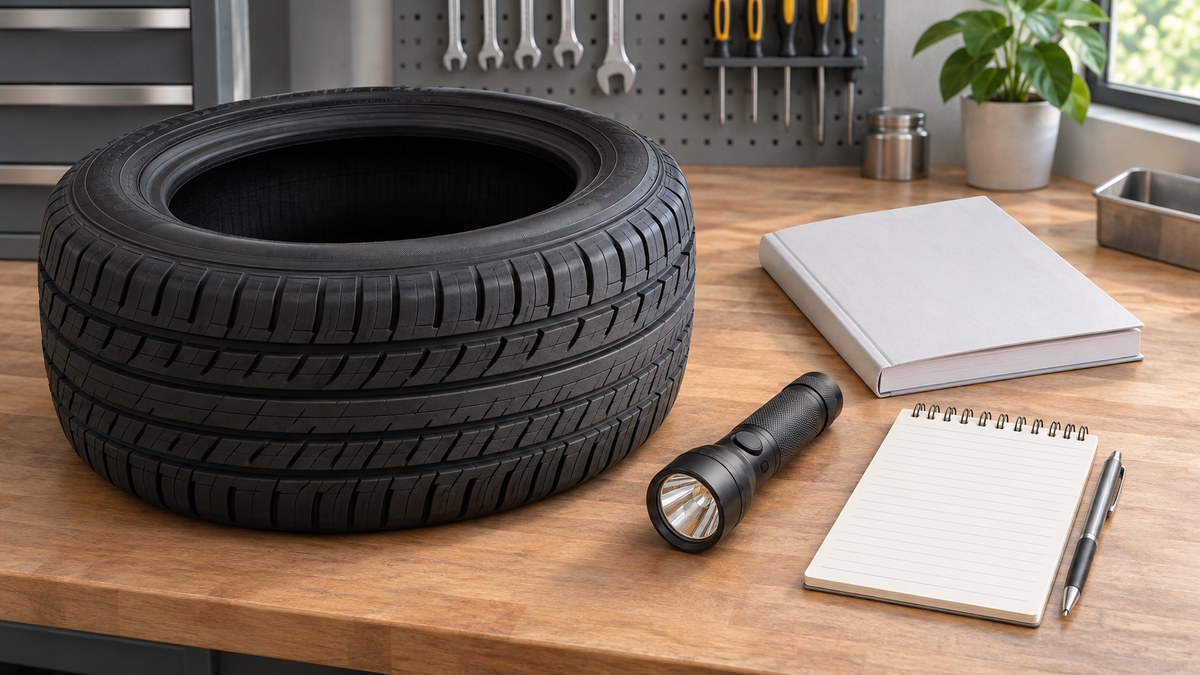
Where to find the tire size on your vehicle
Start with three places: the sidewall, the vehicle’s tire information label and the owner’s manual. Michelin’s tire-size guide explains that these sources answer related but distinct questions. The sidewall identifies the tire currently mounted; the vehicle label and manual provide the manufacturer’s information for the car.
| Location | What it tells you | What to keep in mind |
|---|---|---|
| Tire sidewall | The size and service description of the installed tire | A previous owner may have changed the original setup |
| Driver’s door edge or jamb label | Vehicle manufacturer’s tire and cold-pressure information | Front, rear and spare specifications can differ |
| Owner’s manual | Vehicle-specific tire and wheel guidance | Some models list multiple approved configurations |
| Spare tire sidewall | The spare’s own size and markings | A temporary spare may differ from the road tires |
On the sidewall, look for a group combining numbers, a slash and a letter, rather than the brand name or the DOT identification number. Wipe dirt away with a damp cloth if needed and use a flashlight. Read all four road tires: a replacement may have been installed in the past, and some vehicles use different sizes front and rear.
The National Highway Traffic Safety Administration (NHTSA) advises checking the owner’s manual or the tire label on the driver’s door edge or post for the correct size. If you cannot identify the required specification or the label is damaged, a tire dealer can help.
When reading a sidewall, take a clear photo of the entire marking as well as a written note. Photograph the label separately so the current tire and the vehicle specification are not confused later. If a marking is hidden on the inside of a wheel, do not crawl beneath an unsupported vehicle; ask a shop to read it safely during an inspection.
How to read a tire size: 225/60R17 99H
Consider the example 225/60R17 99H. It is an illustration of how the markings work, not a recommendation for a particular vehicle. Compare your own tire and vehicle information before selecting a replacement.
| Marking | Meaning | How to read the example |
|---|---|---|
| 225 | Nominal section width | Approximately 225 millimeters |
| 60 | Aspect ratio | Sidewall height is 60% of the nominal width |
| R | Radial construction | The letter describes construction, not radius |
| 17 | Wheel diameter | The tire is designed for a 17-inch wheel |
| 99 | Load index | A code for load capacity under specified conditions |
| H | Speed symbol | A tire capability rating under specified conditions |
The aspect ratio is a percentage, not a sidewall height in millimeters. In this example, 60% of the nominal 225-millimeter width is 135 millimeters as a calculation. It is a nominal figure, not a substitute for checking the dimensions and fitment of a specific mounted tire.
The number after R is the wheel diameter in inches; it is not the tire’s overall outside diameter. A tire designed for a 17-inch wheel cannot be mounted on an 18-inch wheel. The complete tire and wheel combination still must meet the vehicle’s requirements for load, clearance and other factors.
Write down the characters after the diameter as well. A tire with the right basic dimensions but an unsuitable load index or speed symbol may not meet the vehicle’s requirements. Your tire professional can compare the entire service description with the manufacturer’s information.
Other sidewall markings serve different purposes. You may see a DOT tire identification number, maximum load information or treadwear markings alongside the size. A vehicle owner’s manual can provide a diagram showing these separate items. For example, this manufacturer manual hosted by NHTSA labels size, service description, maximum load and maximum pressure separately.
The DOT identification number is useful for checking manufacture information and identifying a tire in a recall. NHTSA says the final four digits of a complete modern date code indicate the week and year of manufacture. That code is not the size, and the full number may be molded on only one side of the tire. A technician can help locate it if it is not visible.
Sidewall size versus the door-jamb label
The sidewall is useful when you need to identify a tire already on the car. The door label is a reference for the vehicle manufacturer’s specified equipment and recommended cold inflation pressure. The Michelin guide specifically recommends using the label when fitted tires differ from it, such as on a used vehicle.
A mismatch has several possible explanations: the vehicle may have a suitable alternate wheel-and-tire package, seasonal wheels or aftermarket equipment. It may also have an incorrect tire. The code alone cannot tell you which explanation applies. Compare the car’s label, manual and current wheels, then ask a qualified shop to verify compatibility.
Some vehicles have a staggered setup, with different specifications at the front and rear. Record each axle separately and avoid assuming that all four positions require the same size. An all-wheel-drive vehicle may have additional manufacturer requirements for matching tires; consult its manual and a technician.
If a manual lists several sizes for the same model, do not assume every entry fits every trim. Wheel size, brakes, suspension or factory equipment can differ. The label on the specific vehicle, the manual and a dealer’s fitment information should be considered together.
A practical way to organize the comparison is to record the vehicle label first, then the front and rear sidewalls. If a retailer asks for a size, explain which source you are quoting and mention any difference. That gives the retailer a clearer starting point than a single number copied from a tire whose history is unknown.
What P, LT, load index and speed rating mean
Some sizes begin with a prefix, such as P for a passenger-metric tire or LT for a light-truck tire. A code can also appear without a P. Do not decide that two tires are interchangeable solely because their dimensions look alike; the load capacity, construction and vehicle requirements still need to be checked.
The load index is a code associated with a tire’s load-carrying capacity under specified conditions. It is not the number of pounds printed in plain form. The speed symbol describes a tested capability under defined conditions, not a recommendation to drive at that speed.
Bridgestone’s replacement-tire guidance discusses matching the vehicle placard or manual, including size, load index and speed symbol. Substitutions can involve more than one factor, so use guidance for the exact vehicle and product rather than treating a single number as sufficient.
For trucks, an LT designation or load range can be especially important when carrying or towing loads. Do not replace a light-truck tire with a passenger tire merely because the diameter appears similar. A tire specialist can check the vehicle’s specifications and the proposed tire’s load capacity.
Check all four tires and the spare
Walk around the vehicle and record the full sidewall code at each wheel position. A simple list — front left, front right, rear left and rear right — helps a dealer spot differences. Note the tire make and model as well if you are replacing only one or two tires.
Different sizes on the two axles can be intentional. Differences between the left and right sides may also reflect prior repairs, but you should not diagnose the setup from appearance alone. Follow the vehicle manufacturer’s recommendations and ask a professional about matching, tread depth and drivetrain requirements.
The spare has its own sidewall markings. A compact temporary spare may carry a T prefix and can have different inflation and use restrictions from regular tires. Check the vehicle manual for its limits. Some vehicles use a full-size spare, while others have no spare, so the procedure depends on the vehicle.
On a used vehicle, check the spare even if the four road tires match. A spare can age while sitting unused, and its pressure requirement can differ from the other tires. NHTSA notes that spares are subject to aging; include the spare in regular pressure checks when the vehicle has one and follow the instructions for its specific use.
While checking, look for visible cuts, bulges or other damage. A size code does not establish whether a tire is safe to use. If the tire looks seriously damaged, seek professional or roadside assistance rather than continuing to drive on it.
Can you change tire size?
Sometimes a vehicle can use an approved alternative tire-and-wheel combination, but the decision is more involved than matching the wheel opening. Width, overall diameter, wheel dimensions, load capacity, clearance and vehicle systems all matter. Start with the manufacturer’s approved information and consult a qualified specialist.
A substantially different overall diameter can affect indicated speed and other vehicle behavior. A wider tire can create clearance issues, and a different wheel diameter requires a tire designed for that wheel. Fitment also needs to account for brakes, suspension movement and the vehicle’s drivetrain.
Some truck tires use a flotation-style marking such as 35×12.50R17. In that format the first number generally describes nominal overall diameter in inches, the second nominal width, R radial construction and the last wheel diameter. It is a different notation from a metric example such as 225/60R17.
Mixing the two formats in a search can produce a long list of results, but a numerical comparison is only a starting point. A tire professional can check the wheel’s suitability, load requirements and clearance through the suspension’s range of motion. The fact that a tire can be mounted on a wheel does not by itself establish that it is appropriate for the vehicle.
If you are evaluating an alternate setup, bring the vehicle information, the current wheel dimensions and the intended use to the shop. Do not select a tire only because an online calculator reports a similar diameter. The vehicle and tire manufacturers’ specifications remain the starting point.
Before you order replacement tires
Have the vehicle’s year, make, model and trim available, along with the size information from the label and each tire. Tell the retailer if the vehicle has aftermarket wheels, different front and rear sizes, a temporary spare or another special setup. A VIN can help identify vehicle information but does not reveal every change made after the car left the factory.
Ask the retailer to confirm size, load capacity and speed rating against the vehicle’s requirements. If you want a different size or tire type, ask what manufacturer guidance supports the alternative and what other fitment factors need checking. Preserve the invoice and product information after purchase.
If the vehicle label is missing or unreadable, take the vehicle details to a dealer or qualified tire shop and ask for the manufacturer’s specification. A photograph of the installed tire can help identify the current setup, but it cannot replace a compatibility check.
Remember that tire size and inflation pressure are different details. NHTSA says to use the vehicle manufacturer’s recommended cold pressure on the label or in the manual, rather than the maximum pressure molded into the tire sidewall. Check pressure with a gauge as directed for the vehicle.
If the label specifies different pressures for the front and rear, make a separate note of each. Check the manual for the conditions under which the recommendation applies, including any instructions for a spare or loaded vehicle. A tire-pressure monitoring system is a warning aid and does not remove the need to check pressures with a gauge.
For more practical ownership guides, visit Car Maintenance. If the label and sidewalls disagree, resolve the difference before ordering instead of assuming the existing setup is correct.
Frequently asked questions
Where is my tire size printed?
It is molded into the tire’s sidewall. The vehicle’s tire information label and owner’s manual also provide manufacturer specifications.
What does 225/60R17 mean?
It describes a nominal 225-millimeter width, a 60% aspect ratio, radial construction and a 17-inch wheel diameter.
Does R mean radius?
No. In this type of tire code, R identifies radial construction.
Should I follow the tire sidewall or the door label?
The sidewall identifies the tire installed now; the label gives vehicle manufacturer information. If they differ, have the setup checked.
Can the front and rear tires be different sizes?
Yes. Some vehicles have a manufacturer-specified staggered fitment. Check the label and manual for the specific vehicle.
Does a VIN tell me which tires are on the car now?
It can help identify vehicle information, but it cannot reliably reveal aftermarket changes. Read the current sidewalls too.
Is the DOT code the tire size?
No. The tire identification number includes manufacturing information; it is separate from the size marking.
Can I fit a different size?
Only if the proposed combination is suitable for the vehicle. Consult manufacturer guidance and a qualified tire specialist.


Leave a Reply