
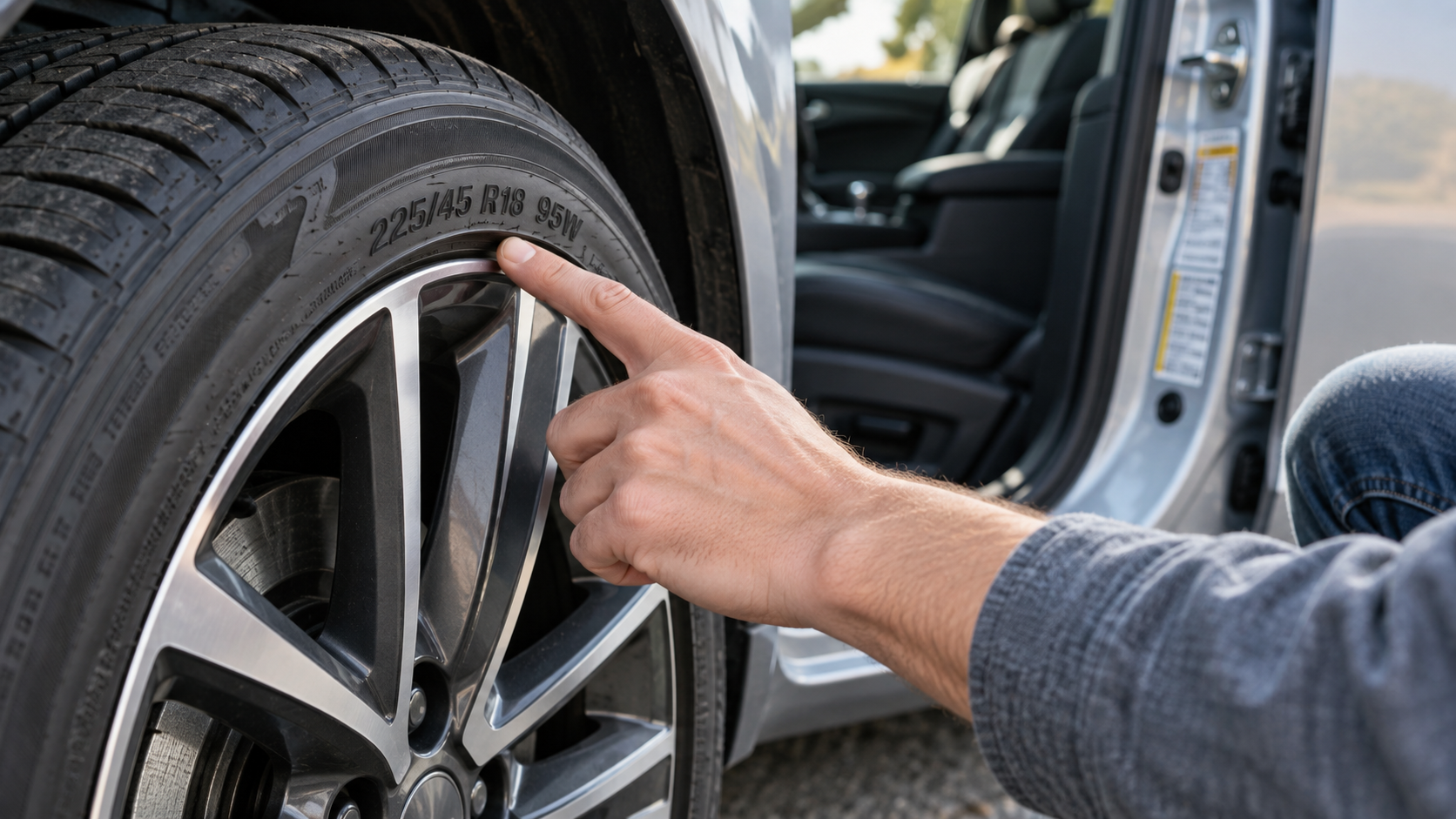
You need new tires, open a tire website, and suddenly it asks for something that looks like a password: 225/60R17 99H.
Wait. Where are you supposed to find that?
The good news is that tire sizing looks far more confusing than it really is. In most cases, you can find the information you need in less than a minute. The tire sidewall is the obvious place to start, but your driver’s door jamb and owner’s manual can be even more important when you’re trying to identify the original tire size for your car.
If you searched for “how to find tire size,” you’re probably dealing with one of three situations: buying replacement tires, checking whether your current tires are correct, or trying to understand all those numbers molded into the rubber.
We’ll cover all three.
And one thing is worth knowing right away: the size currently installed on your vehicle is not always the original factory size. Previous owners change wheels. Drivers install winter setups. Trucks get larger tires. Sometimes the wrong size simply ends up on the car.
So the sidewall tells you what is on the vehicle now. The vehicle label tells you what the manufacturer originally specified.
The Fastest Place to Look: Your Tire Sidewall
Walk over to one of the tires and look at the outer sidewall.
You’ll see a lot of markings: brand name, model name, safety information, load limits, manufacturing codes, and somewhere among all that, the actual size.
A common example looks like this:
225/60R17 99H
That combination is the information most tire shops and online tire retailers need when you shop by size.
You may also see something like:
P215/55R17
or:
LT265/70R17
or, particularly on some trucks and off-road setups:
35×12.50R17
The format changes slightly depending on the tire type, but the sidewall remains the easiest place to identify what is physically installed on the vehicle.
What Does a Tire Size Like 225/60R17 Mean?
Once you know how to break it apart, the mystery pretty much disappears.
| Marking | Example | What It Means |
|---|---|---|
| Tire width | 225 | Nominal tire width in millimeters |
| Aspect ratio | 60 | Sidewall height as a percentage of tire width |
| Construction | R | Radial construction |
| Wheel diameter | 17 | Wheel diameter in inches |
| Load index | 99 | Code representing maximum load capacity |
| Speed rating | H | Speed capability category under specified conditions |
So 225/60R17 describes a tire that is roughly 225 millimeters wide, has a sidewall height equal to 60 percent of that width, uses radial construction, and fits a 17-inch wheel.
The last part, 99H, tells you about load capacity and speed rating.
That does not mean you should automatically buy any tire carrying those numbers. The tire still needs to meet the requirements of your vehicle.
What the First Number Tells You
In a tire marked 225/60R17, the 225 is the nominal section width.
It is measured in millimeters.
A 245 tire is therefore nominally wider than a 225 tire, while a 195 is narrower.
There is a small nuance here. Actual mounted width can vary somewhat between tire models and wheel widths, even when the printed size is identical. So the number is best treated as the standardized size designation rather than a promise that every 225 tire measures exactly 225 millimeters in every setup.
What the Second Number Means
The second number is the aspect ratio.
Take 225/60R17.
The 60 means the sidewall height is 60 percent of the tire’s nominal width.
It does not mean the sidewall is 60 millimeters tall.
This is an easy mistake to make.
A lower aspect ratio generally means a shorter sidewall relative to tire width. That is why performance cars often have sizes such as 245/40R19 while family crossovers may have something like 225/65R17.
One looks visually thinner around the wheel; the other has more sidewall.
What Does the R Mean?
The R means radial construction.
Radial tires dominate modern passenger vehicles in the United States, so you will see this letter constantly.
It does not mean “radius,” even though that guess sounds logical at first.
You may occasionally encounter other construction markings on specialty or older tires, but for the typical modern car, crossover, SUV, or pickup, R is what you’ll usually see.
The Last Size Number Is Your Wheel Diameter
In 225/60R17, the number 17 means the tire is designed for a wheel with a 17-inch diameter.
This part has to match.
A 17-inch tire does not fit an 18-inch wheel. A 19-inch tire does not fit a 20-inch wheel.
It sounds obvious once you say it out loud, but this is one of the most important numbers when ordering tires.
If you upgraded or downsized the wheels on your vehicle, this number will be different from the factory tire size for the original wheels.
Look at the Driver’s Door Jamb Too
The sidewall tells you what tires are currently mounted.
The driver’s door area tells you something different: what the vehicle manufacturer specified.
Open the driver’s door and look around the door jamb or nearby body pillar. Most modern vehicles sold in the U.S. have a tire and loading information label there.
The label typically shows:
- The original tire size for the front wheels.
- The original tire size for the rear wheels.
- Recommended cold tire pressure.
- Seating and load information.
- Sometimes spare-tire information.
For many cars, front and rear tire sizes match.
But not always.
Sports cars and some performance vehicles can use wider rear tires than front tires. This setup is commonly called staggered fitment.
So if the rear tire says something different from the front, do not immediately assume somebody installed the wrong tire.
Sidewall Size vs. Door-Jamb Size: Which One Matters?
Both matter, but they answer different questions.
If you want to know what tire is installed right now, read the tire sidewall.
If you want to know what tire size the vehicle originally came with, check the vehicle label.
| Where You Look | What It Tells You | When It Is Most Useful |
|---|---|---|
| Tire sidewall | Size currently installed | Replacing the exact current tire size |
| Driver’s door jamb | Factory tire specification | Checking original fitment |
| Owner’s manual | Vehicle-specific tire information | Confirming sizes, pressures, and special setups |
| Spare tire | Size of the spare itself | Replacing or servicing the spare |
| Wheel markings | Wheel dimensions, not full tire size | Checking wheel compatibility |
What if they do not match?
That does not automatically mean there is a problem.
Your car may have optional wheels, an approved alternate size, winter tires, or aftermarket wheels. But if you have no idea why the sizes differ, it is worth checking before buying replacements.
What Does the P Before the Tire Size Mean?
Some passenger tires begin with the letter P, such as P215/60R16.
The P indicates a P-metric tire intended primarily for passenger vehicles.
Many modern tire sizes appear without that P and simply start with the width, such as 225/55R18.
Do not panic if your old tire includes a P and the product listing you are reading does not. Tire sizing and service specifications need to be compared as a whole rather than by one letter alone.
When in doubt, match the manufacturer’s requirements or ask a qualified tire shop to confirm compatibility.
What Does LT Mean on a Tire?
LT normally identifies a tire designed for light-truck applications.
You might see something like LT265/70R17.
Light-truck tires may have different load ranges, inflation requirements, construction characteristics, and load capabilities than passenger tires.
This is especially important for pickup trucks, vans, towing vehicles, and SUVs that may carry substantial loads.
Do not replace an LT tire with a passenger tire simply because the dimensions look similar.
The tire must still provide the load capacity and characteristics required by the vehicle.
What Is the Load Index?
After the main tire size, you may see a two- or three-digit number.
For example:
225/60R17 99H
The 99 is the load index.
It corresponds to a specific maximum load the tire can support when properly inflated under defined conditions.
The number itself is a code, not the number of pounds the tire can carry.
This matters when buying replacements. A tire with the right physical size but an inadequate load rating may not meet the requirements of the vehicle.
And What About the Speed Rating?
The letter after the load index is the speed rating.
Common ratings include letters such as T, H, V, W, and Y.
The rating represents the tire’s tested speed capability under specified conditions. It also tends to relate to tire construction and performance characteristics.
This does not mean a driver should treat the rating as a recommended driving speed. Speed limits and safe road conditions still apply.
When replacing tires, match the vehicle manufacturer’s required service description rather than shopping only by dimensions and price.
How to Find Tire Size in the Owner’s Manual
If the tire sidewall is difficult to read or the door label is damaged, the owner’s manual is another useful place to look.
Search the index for terms such as tires, tire specifications, wheels, inflation pressure, or loading.
Some vehicles were offered with several wheel-and-tire combinations from the factory. The manual may therefore list more than one size.
That does not mean every listed size can be installed on every version without checking.
Brake size, wheel width, suspension package, trim level, drivetrain, and other factors can affect fitment.
Could Your Car Have More Than One Factory Tire Size?
Absolutely.
A single model may leave the factory with 16-inch wheels on the base trim, 18-inch wheels on a higher trim, and 19-inch wheels on a sport package.
The overall tire diameter may remain relatively similar even though the wheel gets larger and the tire sidewall gets shorter.
For example, different trims might use setups resembling:
205/65R16
225/55R18
235/45R19
These are just examples of how manufacturers can pair different wheel diameters with different tire profiles.
That is why searching only by vehicle model can sometimes return several results.
How to Check All Four Tires
Do not read one tire and assume the other three match.
Walk around the car.
This sounds almost too basic, but used vehicles occasionally end up with mismatched tires. One may have been replaced after a puncture, or a previous owner may have mixed models, load ratings, or even sizes.
Check:
- Front-left tire size.
- Front-right tire size.
- Rear-left tire size.
- Rear-right tire size.
- Load index and speed rating.
- Whether the vehicle intentionally uses staggered sizing.
All-wheel-drive vehicles deserve extra attention because differences in tire diameter and tread depth can matter to the drivetrain. Follow the vehicle manufacturer’s requirements when replacing tires.
Where Is the Tire Size on a Spare?
The spare has its own size printed on its sidewall.
Compact temporary spares often look dramatically narrower than normal tires and may carry size markings that look different from the four road tires.
You might also see a T prefix on certain temporary spare sizes.
Do not assume the spare should match the regular tires.
Some vehicles have full-size spares. Others have compact temporary spares, and many newer cars do not carry a spare at all.
The inflation pressure for a compact spare can also be much higher than the pressure used in the regular tires, so check its label and the vehicle information.
How to Read a Truck Tire Size Like 35×12.50R17
Some truck and off-road tires use a sizing format that feels much more intuitive to American drivers.
Take 35×12.50R17.
The 35 refers roughly to the tire’s overall diameter in inches.
The 12.50 refers to the nominal width in inches.
R indicates radial construction.
And 17 refers to the 17-inch wheel diameter.
This type of sizing is common in the off-road world, where drivers talk about “33s” or “35s.”
But fitting larger tires is not simply a matter of whether they physically bolt onto the wheel.
Clearance, suspension travel, steering, gearing, speedometer accuracy, wheel offset, load capacity, and braking performance can all become part of the picture.
Can You Find Tire Size Using Your VIN?
The Vehicle Identification Number can help identify how a vehicle was originally configured, and tire shops or dealership systems may use vehicle information to narrow down possible factory fitments.
But a VIN does not tell you what aftermarket wheels or tires are currently installed.
That is the key limitation.
If somebody replaced the original 17-inch wheels with 19-inch wheels five years ago, looking up the factory specification does not magically identify the tires sitting on the car today.
For current fitment, inspect the actual tires and wheels.
What If the Tire Sidewall Is Too Dirty to Read?
This happens more often than you’d think, especially on trucks.
Turn the steering wheel to make the front tire easier to see. Wipe the sidewall with a damp cloth and look for the group of large numbers around the outer surface.
A flashlight helps.
Do not confuse the tire size with the DOT identification code. The DOT code serves a different purpose and includes manufacturing information.
Do Not Confuse Tire Size With the DOT Date Code
While you are looking at the sidewall, you will probably notice the letters DOT followed by a longer sequence.
Near the end of the full Tire Identification Number, the final four digits indicate the week and year of manufacture.
For example, a date code ending in 2325 indicates the tire was manufactured during the 23rd week of 2025.
That code tells you the tire’s manufacturing date, not its size.
Also, the full DOT Tire Identification Number may appear on only one sidewall, so you may need to look at the inner side of the tire for the complete code.
What If Your Current Tires Do Not Match the Door Label?
First, do not assume disaster.
There are legitimate reasons for a difference.
- The vehicle has factory optional wheels.
- An approved alternate tire size has been installed.
- The car is running a winter wheel-and-tire package.
- A previous owner installed aftermarket wheels.
- The vehicle uses a customized truck or off-road setup.
- The current tires may simply be incorrect.
The question is whether the alternate setup is compatible with the vehicle.
If you are not sure, a professional tire shop can check wheel size, tire diameter, load capacity, clearance, and other fitment requirements.
Can You Change Tire Size?
Yes, within limits.
Drivers change tire sizes for many reasons. Some want larger wheels. Some want additional sidewall for winter roads. Truck owners may want more ground clearance. Performance drivers may install wider tires.
But changing one number changes more than appearance.
Tire diameter can affect speedometer readings. Width can affect clearance. Different wheel diameters require different tires. Load ratings must remain appropriate. Tire circumference can also matter for ABS, traction control, stability systems, and all-wheel-drive systems.
If you are moving away from factory sizing, treat it as a fitment question, not just a style decision.
Why Overall Tire Diameter Matters
Your car effectively expects the tire to travel a certain distance with each rotation.
Install a substantially taller tire and the vehicle travels farther per revolution. Install a much shorter tire and it travels less.
That can affect speedometer and odometer readings.
It can also change effective gearing.
This is why “plus sizing” often pairs a larger wheel with a lower-profile tire. The goal is usually to keep total tire diameter relatively close to the original while changing the wheel-to-sidewall relationship.
Can the Same Tire Size Fit Different Vehicles?
Yes.
The same printed tire size can appear on several very different cars or SUVs.
But identical dimensions do not automatically mean identical suitability.
Load index, speed rating, tire type, original-equipment specifications, and sometimes special manufacturer markings can differ.
So seeing 235/55R19 on another vehicle does not prove that its tire is right for yours.
What Information Should You Have Before Buying Tires?
At minimum, write down the complete tire size and check the vehicle label.
Do not stop after the first three numbers.
If your existing tire says 225/60R17 99H, keep the 99H information too. Your tire retailer needs to make sure the replacement meets appropriate load and speed requirements.
You should also know whether the car uses run-flat tires, whether the front and rear sizes differ, and whether you have factory or aftermarket wheels.
FAQ
Where do I find my tire size?
The quickest place is the tire sidewall. Look for a marking such as 225/60R17. You can also check the tire and loading information label inside the driver’s door area for the factory specification.
Is the tire size printed on every tire?
Yes, the tire size is molded into the sidewall. Some other information, including parts of the DOT identification code, may appear differently on the two sides of the tire.
What does 225/60R17 mean?
225 is the nominal width in millimeters, 60 is the aspect ratio, R indicates radial construction, and 17 means the tire fits a 17-inch wheel.
Should I use the tire size on the sidewall or the door label?
The sidewall tells you what is installed now. The door label shows the manufacturer’s original specification. If they differ and you do not know why, confirm compatibility before ordering new tires.
Can front and rear tires be different sizes?
Yes. Some vehicles come from the factory with staggered tire sizes, usually with wider tires in the rear. Check the vehicle label or owner’s information before assuming they should match.
Does my VIN tell me my tire size?
Vehicle information tied to the VIN can help identify original factory equipment, but it does not necessarily tell you what aftermarket tires or wheels are installed now.
Can I install a different tire size than the one listed on my car?
Sometimes, but the alternative must be suitable for the vehicle. Overall diameter, width, load capacity, wheel size, clearance, drivetrain requirements, and other factors all matter.
Conclusion
Finding your tire size is one of those car jobs that looks technical until you know where to look.
Start with the sidewall.
A marking such as 225/60R17 gives you the basic dimensions of the tire currently installed on your vehicle. The width comes first, then the aspect ratio, construction type, and wheel diameter.
But don’t stop there.
Open the driver’s door and check the tire and loading information label. That tells you what the vehicle manufacturer specified, and it can quickly reveal whether your current tires match the original setup.
If the two sizes are different, there may be a perfectly reasonable explanation. Your car could have optional wheels, winter tires, a staggered setup, or aftermarket rims.
Or somebody may have installed the wrong tire years ago.
That is exactly why checking both places is worth the extra minute.
And when you are shopping, write down the entire service description rather than only the basic size. A tire marked 225/60R17 99H tells you more than 225/60R17 alone. Load capacity and speed rating matter too.
Truck owners should pay particular attention to LT markings, load ratings, and non-metric sizes such as 35×12.50R17. Bigger is not automatically better, and physically fitting inside the wheel well is only one piece of the fitment puzzle.
The same applies if you’re changing wheel diameter. A 17-inch tire cannot simply be moved onto an 18-inch wheel. The tire size has to match the wheel, and the complete setup has to work correctly with the vehicle.
One final habit is worth picking up: check all four tires.
Used cars sometimes hide funny surprises. One replacement tire here, a different model there, maybe even mismatched sizes after years of repairs. A thirty-second walk around the vehicle can save a lot of confusion when you order a new set.
So if somebody asks how to find tire size, the short version is easy.
Read the tire sidewall for the current size.
Check the driver’s door label for the factory size.
Compare the two.
And if they do not match, figure out why before clicking “buy.”
Once you know what 225/60R17 actually means, those strings of numbers stop looking like secret automotive code. They are simply a compact description of what fits around your wheels.
Leave a Reply