
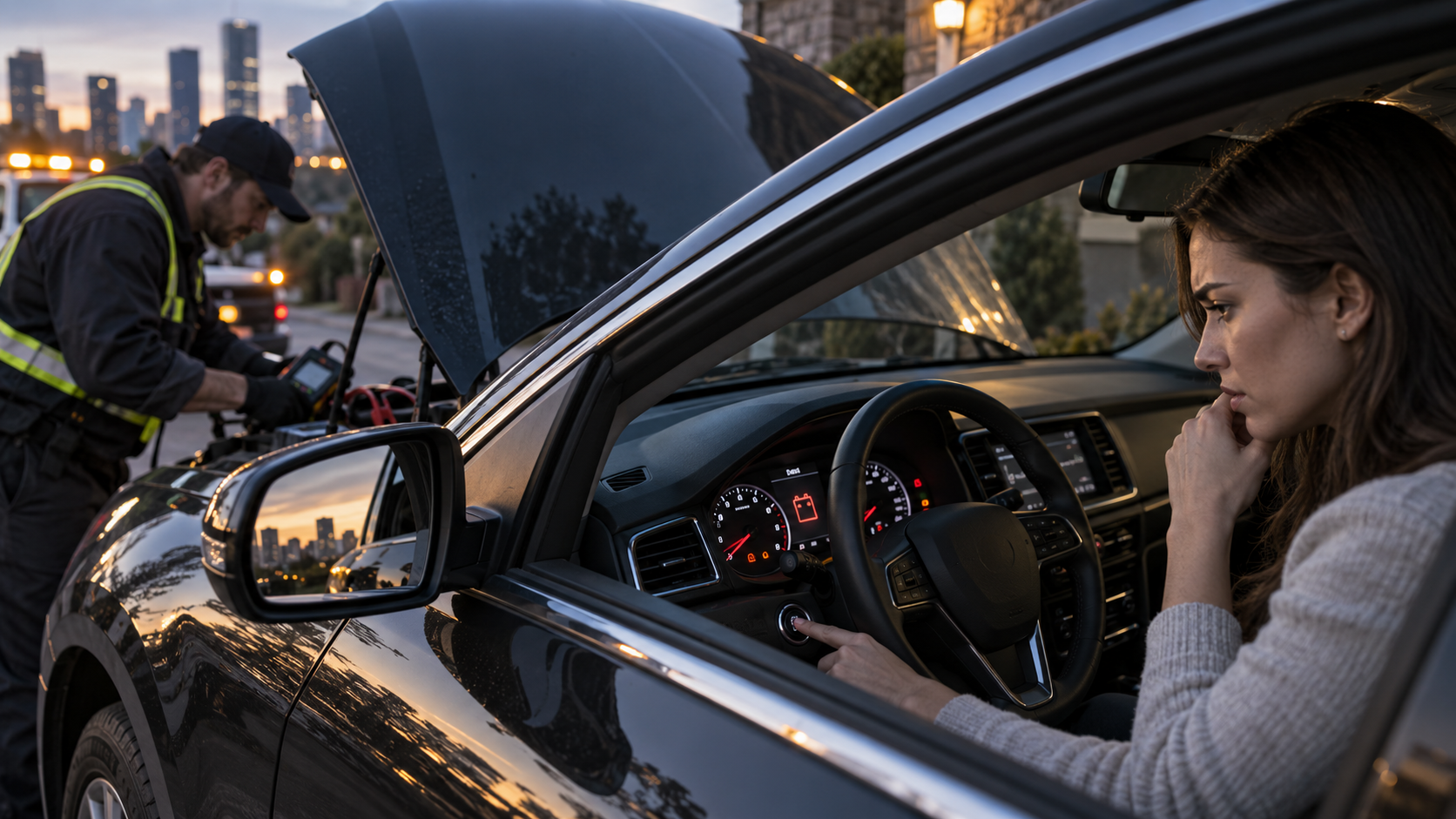
You turn the key or press the start button, expecting the engine to fire. Instead, you hear a click.
Maybe it is one solid click. Maybe it sounds like a fast machine-gun rattle. Maybe the dashboard lights come on normally, but the engine does absolutely nothing except click once.
A clicking sound when starting car engines is one of those symptoms that sounds simple but can point to several different problems. The battery is an obvious suspect, and often it really is the battery. But starter motors, electrical connections, ground cables, relays, charging problems, and even mechanical issues can create similar sounds.
The good news is that the pattern of the click tells you quite a lot.
Rapid clicking usually sends the diagnosis in one direction. A single heavy click sends it somewhere else. No lights, no crank, and barely any sound changes the picture again.
So before buying a starter or blaming the battery, pay attention to exactly what happens when you try to start the car.
First, What Actually Happens When You Start a Car?
When you turn the key or press the start button, the vehicle has to complete several electrical and mechanical steps almost instantly.
The battery supplies electrical power. The starter circuit receives the start request. A relay or control circuit activates the starter solenoid. The solenoid engages the starter motor with the engine’s flywheel or flexplate, and the starter turns the engine fast enough for combustion to begin.
Once the engine starts, the starter disengages.
That whole sequence may take only a second or two when everything is healthy.
A click often means part of that sequence is happening, but the starter motor is not actually turning the engine as expected.
Rapid Clicking Usually Points Toward Low Voltage
If you hear a fast series of clicks when you try to start the car, low battery voltage is one of the most common explanations.
Here is what happens.
The starter solenoid tries to engage. That requires electrical power. As soon as the starter attempts to draw heavy current, battery voltage drops too low. The solenoid releases. Voltage rises again. The solenoid engages again.
Click-click-click-click-click.
It can happen several times per second.
A weak battery may still have enough power to run dashboard lights, the radio, or interior lighting. Those devices require far less current than the starter motor.
That is why the familiar argument of “the lights work, so the battery must be fine” does not always hold up.
One Solid Click Can Mean Something Different
A single strong click with no engine cranking often points more toward the starter circuit or starter motor itself.
The starter solenoid may be engaging, but the starter motor does not turn.
Possible causes include a failing starter motor, poor battery connection, damaged starter cable, weak ground connection, starter-solenoid problem, or inadequate battery power that does not create the classic rapid-click pattern.
And occasionally, the starter works but the engine cannot rotate because of a serious mechanical problem.
That last possibility is much less common than a battery or starter issue, but it is one reason diagnosis matters before replacing parts.
| What You Hear | What the Engine Does | Common Direction to Check |
|---|---|---|
| Rapid repeated clicking | Does not crank | Weak battery, discharged battery, poor battery connection |
| One loud click | Does not crank | Starter, solenoid, cables, battery connection |
| Very faint click | No crank | Low battery voltage, relay, wiring, connection issue |
| Click followed by slow cranking | Engine turns slowly | Weak battery, poor cables, starter drawing excessive current |
| No click at all | No crank | Battery, ignition/start circuit, relay, neutral-safety system, security system |
| Starter spins but engine does not turn | No normal cranking | Starter drive or flywheel engagement problem |
The Battery Is Still the First Place to Look
Starting an engine takes a large burst of current.
A battery can appear normal right up until the starter asks it to deliver that current.
Cold weather often exposes a marginal battery because battery performance drops as temperatures fall, while cold engine oil can make the engine harder to turn.
Heat can age batteries too. High under-hood temperatures speed up chemical wear, so a battery that fails on the first cold morning may have been deteriorating for months.
Other things can discharge an otherwise healthy battery:
- Headlights or interior lights left on.
- A vehicle sitting unused for a long period.
- A charging-system problem.
- An electrical drain while the car is parked.
- A loose or corroded battery connection.
- Repeated very short trips that do not restore much battery charge.
- An aging battery with reduced capacity.
If jump-starting the vehicle immediately restores normal cranking, the battery or charging system becomes a strong area to investigate.
But jump-start success does not automatically prove the battery itself is bad.
The battery may simply be discharged because the alternator is not charging correctly or because something is drawing power while the car sits.
Battery Terminals Can Cause More Trouble Than They Look Like
Starter motors require a lot of current, so even a connection that seems only slightly loose can become a major problem during starting.
Corrosion around battery posts and terminals can increase electrical resistance.
You may see white, blue, or greenish buildup around the connection. Sometimes the outside looks fairly clean while corrosion exists between the terminal and battery post.
A terminal can also be physically loose.
If you can rotate the battery clamp by hand, that is not a good connection.
Do not casually place metal tools across battery terminals. A vehicle battery can supply extremely high current through a short circuit.
If you are not comfortable cleaning or tightening battery connections safely, have the system checked.
Ground Cables Matter Just as Much
Electricity needs a complete circuit.
The positive battery cable gets plenty of attention, but the ground side is equally important.
The battery negative terminal connects to the vehicle body and engine through ground cables or straps. If those connections loosen, corrode, or break internally, the starter may not receive the current it needs.
A bad ground can create clicking, slow cranking, intermittent starting, dimming lights, or other strange electrical symptoms.
Sometimes moving a cable seems to “fix” the car temporarily. That is a clue, not a repair.
Could the Starter Motor Be Bad?
Absolutely.
The starter motor experiences heat, vibration, electrical load, and mechanical wear every time the vehicle starts.
Inside the starter are electrical and mechanical components that can wear over time.
A failing starter may work one morning and refuse to turn the engine later that afternoon.
You may hear one solid click because the solenoid engages but the starter motor itself does not rotate.
Sometimes repeated attempts eventually make the starter work again. That can happen with worn internal contacts or areas inside the motor where electrical contact has become unreliable.
Do not take temporary recovery as proof that the problem disappeared.
An intermittent starter usually becomes less intermittent eventually, and usually not at a convenient time.
What Is the Starter Solenoid?
The starter solenoid is essentially a heavy-duty electrical switch combined with a mechanical actuator.
When you request a start, the solenoid helps engage the starter drive with the engine and connects battery current to the starter motor.
The click you hear can actually be the solenoid moving.
If it clicks but does not successfully power the motor, the fault could be inside the starter assembly or elsewhere in the high-current circuit.
On many modern vehicles, the solenoid is part of the starter assembly rather than something that is replaced separately during a typical repair.
Can a Bad Starter Relay Cause Clicking?
Yes, depending on the vehicle and circuit design.
A starter relay lets a relatively low-current control circuit operate the much heavier starter circuit.
A failing relay may click but fail to provide reliable electrical contact.
However, hearing a click from the relay does not prove the relay is defective.
The click only tells you that the relay coil is being activated.
Testing voltage entering and leaving the circuit is much more useful than replacing the relay based on sound alone.
What If the Dashboard Lights Go Dim?
Watch the instrument panel when you try to start the engine.
If the lights become dramatically dim or go almost completely dark, there may be a battery, cable, connection, or starter-current problem.
A starter draws a lot of electrical power. Some dimming can be normal. A complete collapse of electrical power is different.
If the lights stay bright but nothing happens except one click, attention may shift more toward the starter circuit, though battery testing still matters.
This little observation costs nothing and can be surprisingly useful.
What If Everything Goes Dead After the Click?
Suppose the dashboard lights are normal, you turn the key, hear a click, and suddenly the entire car goes dark.
Then the lights return later.
A loose or poor battery connection becomes especially suspicious.
The heavy starter load can cause an already weak connection to lose electrical contact. Once the load disappears, the circuit reconnects enough for low-current electronics to wake back up.
That is a very different symptom from a starter that clicks while all the dashboard lights remain stable.
Could the Alternator Be Responsible?
Indirectly, yes.
The alternator does not normally crank the engine during startup. The battery handles that job.
But once the engine is running, the alternator supplies electrical power and restores energy to the battery.
If the charging system fails, the vehicle may continue running temporarily on battery power until voltage drops too low.
After parking, you may discover the battery does not have enough energy left to restart the engine.
You hear rapid clicking and naturally blame the battery.
The battery may indeed be discharged, but the underlying problem could be the charging system.
If you jump-start the car and the battery soon goes flat again, charging-system testing becomes especially important.
How Battery, Starter, and Alternator Problems Differ
| Possible Problem | Typical Starting Symptom | Other Clues |
|---|---|---|
| Weak battery | Rapid clicking or slow cranking | Dim lights, improves with jump-start |
| Loose battery connection | Clicking, intermittent no-start | Electrical power may cut in and out |
| Bad starter | Single click or intermittent no-crank | Battery tests good, lights may stay bright |
| Starter relay/circuit problem | Click or no crank | Starter may not receive proper voltage |
| Charging-system fault | Battery gradually becomes too weak to crank | Repeated discharged battery, charging warning may appear |
| Poor engine ground | Slow crank or clicking | Intermittent electrical behavior |
What About a Click With No Dashboard Lights?
If the vehicle has almost no electrical power, start with the battery and main electrical connections.
A deeply discharged battery may not even power the dashboard normally.
But a disconnected or badly corroded battery cable can create the same general effect.
If the car has electrical power until you attempt to start it and then everything disappears, look closely at those high-current connections.
Could the Neutral Safety Switch Be Involved?
Automatic-transmission vehicles normally allow the starter to operate only in Park or Neutral.
A transmission-range sensor or related circuit tells the vehicle which gear is selected.
If the system does not recognize Park correctly, the engine may not crank.
Sometimes trying Neutral instead of Park changes the symptom.
That does not prove the switch is bad, but it is useful information for diagnosis.
Manual-transmission vehicles may have a clutch-position switch that performs a similar safety function.
What About Push-Button Start Cars?
The basic starter still needs battery power even when there is no traditional ignition key.
But push-button systems add more electronic logic.
The vehicle may need to detect the key fob, verify that the brake pedal is pressed, confirm transmission position, and approve the start request through control modules.
A weak 12-volt battery can still create clicking or strange electronic behavior.
A weak key-fob battery, on the other hand, may prevent key recognition on some vehicles but does not normally create the same heavy rapid clicking associated with a discharged vehicle battery.
Can a Security System Stop the Car From Starting?
Yes.
Modern immobilizer systems can prevent starting when the vehicle does not recognize an authorized key.
The exact behavior varies by manufacturer.
Some vehicles may crank but not start. Others may prevent starter operation.
If a security or key warning appears on the dashboard at the same time as the no-start condition, mention that during diagnosis.
But if you hear classic rapid starter clicking and the lights dim heavily, battery voltage still deserves immediate attention.
Is Clicking More Common in Cold Weather?
Cold mornings often reveal weak starting systems.
A battery produces less available power at low temperatures, while the engine may require more effort to crank.
That combination is rough on a battery that was already close to the edge.
You may notice:
- Slower-than-normal cranking before the engine starts.
- Rapid clicking on particularly cold mornings.
- Interior lights dimming heavily during starting.
- A car that starts normally after temperatures rise.
- A battery that repeatedly needs a jump during winter.
If the battery struggles only in cold conditions, do not assume warmer weather permanently fixed it.
The temperature may simply be exposing reduced battery capacity.
Why Can the Car Start After Several Attempts?
This behavior often confuses people.
Turn the key: click.
Try again: click.
Third try: the engine suddenly cranks normally and starts.
That can happen with an intermittent starter, worn starter-solenoid contacts, poor electrical connections, or a marginal control circuit.
It can also happen when a battery connection shifts slightly between attempts.
The fact that the car eventually starts does not make the symptom harmless.
Intermittent electrical problems tend to become permanent sooner or later.
Can You Tap the Starter to Make It Work?
You may have heard the old roadside trick of tapping a failing starter while someone turns the key.
On certain older starter designs, vibration could occasionally help worn internal components make contact temporarily.
But this is not a real repair, and accessing the starter can be unsafe depending on its location.
Do not crawl under a vehicle that is not properly supported. Never work around moving engine components while someone is attempting to start the car.
If a starter only works after being hit, it has given you a pretty clear message anyway: it needs attention.
Can You Jump-Start a Car That Is Clicking?
If the battery is discharged and the vehicle is otherwise healthy, a proper jump-start may get it running.
But connecting jumper cables incorrectly can damage electrical components or create sparks near the battery.
Follow the vehicle manufacturer’s procedure because jump points and battery locations differ between models.
Hybrid and electric vehicles deserve extra caution. Their 12-volt systems and designated jump points may not be arranged like those in a conventional gasoline vehicle.
If the battery is visibly damaged, leaking, swollen, or frozen, do not attempt a normal jump-start.
What Should You Check Before Calling for a Tow?
You do not need to dismantle the vehicle in a parking lot.
A few simple observations can still help.
- Look at whether dashboard lights are bright or dim.
- Listen for one click or repeated rapid clicking.
- Check whether the battery terminals appear loose or heavily corroded.
- Try starting in Neutral if your automatic vehicle allows it.
- Look for security or key warnings on the dashboard.
- Think about whether the car recently needed a jump.
- Remember whether a charging warning appeared during your last drive.
- Notice whether the problem changes when the engine is hot or cold.
If the electrical system behaves strangely or you are not comfortable working around the battery, stop there. Those observations are already useful to a technician.
How a Mechanic Tests a Clicking No-Start
A good diagnosis generally starts with battery condition and voltage.
The technician may perform a battery test rather than relying only on resting voltage. A battery can show reasonable voltage with no load and still fail when asked to deliver starter current.
Connections and cables are inspected next.
Voltage-drop testing is particularly useful because it can identify excessive resistance in positive or ground cables while the starter circuit is under load.
If battery power and connections are good, testing can continue at the starter and control circuit.
A technician may check whether the starter receives proper voltage when the start command is given.
If full power reaches the starter but the motor does not crank, the starter becomes a much stronger suspect.
If the starter never receives the required signal, diagnosis moves backward through relays, wiring, switches, transmission-position inputs, control modules, or related circuitry.
Why Replacing the Battery First Is Not Always Smart
Battery replacement is easy to understand, so it is often the first guess.
Sometimes that guess is correct.
But if the battery is only discharged because the alternator is not charging, the new battery will eventually go flat too.
If the actual problem is a high-resistance cable, a new battery may temporarily mask the issue because it can produce more current than the old one.
If the starter is failing, a fresh battery may make it work a little better for a while.
Testing the system gives you a cleaner answer than swapping parts until the clicking stops.
Could the Engine Itself Be Locked Up?
It is possible, but much less common than battery, connection, or starter problems.
If the engine cannot rotate mechanically, the starter may produce one heavy click because it is trying to turn something that will not move.
Serious internal engine damage, liquid entering a cylinder, or certain accessory failures can prevent normal rotation.
A technician can verify whether the engine turns manually before condemning the starter.
If the engine stopped suddenly while driving and now produces only a heavy click during starting, mention that history immediately. It changes the diagnosis significantly.
What if the Clicking Started After Engine Work?
Recent repairs are worth mentioning.
A battery cable may not have been tightened fully. A ground strap might have been left loose. A connector could have been disturbed. The battery may have discharged while doors remained open during the repair.
It is also possible that the new problem is unrelated.
Still, timing is useful information.
If the car never had starting trouble before a recent repair and began clicking immediately afterward, the work area deserves a careful check.
Can Clicking Be a Sign of a Bad Battery Even if It Is New?
Yes.
New batteries can be discharged, defective, incorrectly installed, or connected poorly.
A replacement battery also does not repair a charging-system problem.
If a new battery becomes weak quickly, test the charging system and check for unwanted electrical draw rather than assuming another battery will solve it.
How Urgent Is a Clicking No-Start?
The immediate problem is fairly obvious: the car may leave you stranded.
But most clicking no-start conditions are not the same kind of emergency as an overheating engine or low oil-pressure warning.
The concern is usually reliability and finding the electrical or starter fault before the vehicle stops starting altogether.
One exception is visible battery damage, strong electrical burning smells, smoke, or unusually hot cables.
If you notice those signs, stop attempting to start the vehicle and arrange professional help.
FAQ
Why does my car make a rapid clicking sound when I try to start it?
Rapid clicking commonly means battery voltage is dropping too low when the starter tries to operate. A discharged battery, weak battery, loose terminals, or poor cable connection can cause it.
Why does my car click once but not start?
A single click can happen when the starter solenoid engages but the starter motor does not turn. Possible causes include a failing starter, weak battery, poor cable connection, ground problem, or starter-circuit fault.
Can a bad battery still turn on the lights?
Yes. Lights and electronics need much less current than the starter. A weak battery can power the dashboard normally but fail when asked to crank the engine.
Will jump-starting tell me whether the battery is bad?
Not completely. If a jump-start works, low available battery power was probably part of the problem, but the battery may simply be discharged because of a charging fault or electrical drain.
Can a bad starter work sometimes?
Yes. Starters can fail intermittently. A worn starter may click several times and then suddenly operate normally. Intermittent operation usually means the problem still needs attention.
Can a bad alternator cause clicking when starting?
Indirectly. A failed charging system may leave the battery too discharged to operate the starter. The resulting symptom can be rapid clicking even though the original problem began with the alternator.
Should I replace the battery or starter first?
Test first. Battery condition, cable voltage drop, starter power supply, and starter operation can usually narrow down the fault without replacing parts on a guess.
Conclusion
A clicking sound when starting car engines is usually your first clue that the starting system does not have enough electrical power or cannot turn the engine normally.
The sound itself matters.
Rapid clicking often points toward low voltage, a discharged battery, or poor battery connections.
One solid click can shift attention toward the starter, solenoid, cables, or ground circuit.
And if there is no click at all, the problem may sit elsewhere in the start-control circuit.
Start with the simple observations.
Are the dashboard lights bright? Do they dim heavily when you turn the key? Does everything go dead? Is the clicking rapid or just one solid knock? Does the vehicle start with a jump?
These little details can save a surprising amount of diagnostic time.
Just do not fall into the trap of assuming that every clicking car needs a new battery.
The battery might be weak because the alternator stopped charging it. A cable might have too much resistance. A ground connection may be corroded. The starter itself may have worn internally.
Sometimes the fix is simple. Clean and tighten a connection, recharge the battery, and the car is back to normal.
Other times the clicking is the warning you get just before an intermittent starter stops working completely.
If the car starts after several attempts, that is useful information, but it is not reassurance.
Starting systems often fail gradually. A starter that works on the fourth try today might not work at all tomorrow.
And if a battery repeatedly needs a jump, find out why rather than treating the jumper cables as permanent equipment.
A healthy charging and starting system should not require regular rescue.
When possible, have the battery tested under load, inspect the terminals and grounds, and verify that the starter is receiving the voltage it needs.
Those checks separate a weak battery from a bad connection or failing starter much more reliably than listening to the click alone.
If you notice smoke, a strong burning smell, damaged battery casing, unusually hot cables, or other serious electrical symptoms, stop trying to start the vehicle and get professional help.
Otherwise, treat the clicking as a useful clue.
The car is not being mysterious. Something in the starting sequence is trying to work and not quite getting there.
Figure out which step is failing, and the repair usually becomes much less of a guessing game.
Leave a Reply